

Hello everyone, this is Global CPA ✨
It’s been a while since my last USCPA post.
Recently, many junior accountants who finished the second stage of the KICPA exam have been asking me about the USCPA path. While researching the licensing process myself, I also realized that the demand for the USCPA is much larger than I originally expected.
So in this post, I wanted to organize the very first step of the USCPA journey:
how to actually apply for the exam.
Honestly, for many people who completed all of their education domestically and have little experience with international systems, even attempting to register for a foreign professional exam can feel intimidating at first.
I probably would have struggled much more myself if I had not started the process together with a friend who was already comfortable using English.
Thankfully, thanks to that friend, I was able to complete the application process smoothly and eventually pass the exam.
So for anyone hesitating to begin the USCPA journey, I’ll try to organize everything step by step — from exam registration, study methods, and section strategies to actual testing experiences throughout this series.
Overall Process
FACSUSA Registration
→ Evaluation Application & Document Submission
→ Fee Payment
→ NTS Issuance
→ Exam Scheduling
1. Registering on the FACSUSA Website
The very first step depends on where you completed your university education.
- Graduates of U.S. universities generally apply directly through NASBA
- Graduates of non-U.S. universities usually begin through FACSUSA
NASBA is essentially the central administrative organization for the USCPA system.
The acronym stands for:
National Association of State Boards of Accountancy
Since CPA licensing in the United States is managed separately by each state board, NASBA functions somewhat like the overall coordinating organization.
If you graduated outside the United States, your academic credits must first be evaluated to determine whether they satisfy U.S. CPA eligibility requirements.
That evaluation process is handled by credential evaluation agencies such as FACSUSA.
FACSUSA stands for:
Foreign Academic Credential Service, Inc.
Many international candidates use FACSUSA not only for the USCPA exam, but also for various other U.S. licensing and academic purposes.
For candidates applying through states such as Maine or Vermont — two states especially popular among international candidates — FACSUSA evaluation is essentially mandatory.
Official website:
1-1. Starting the Evaluation Application
After entering the website:
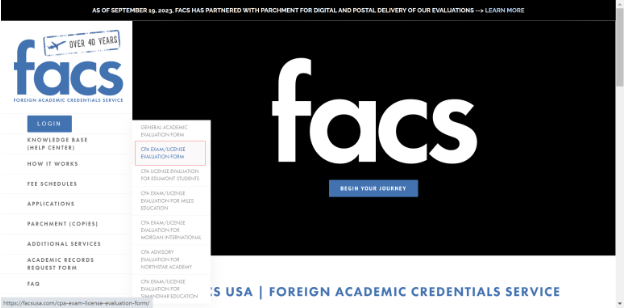
Application
→ CPA EXAM/LICENSE Evaluation Form
Then select:
“CPA Exam License Evaluation”
On the first page, you will enter basic personal information such as:
- address
- country of birth
- contact details
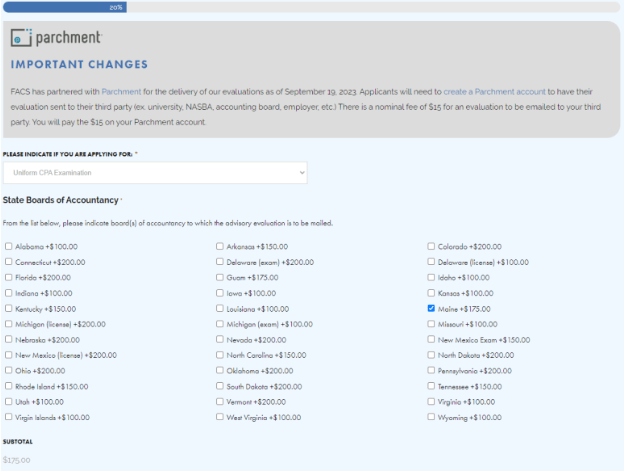
After that, select:
“Uniform CPA Examination”
and choose the state where you intend to apply.
The term “Uniform CPA Examination” basically means that although CPA licensing is handled separately by each state board, the examination itself is standardized across the United States.
You will then add your university information and academic background.
1-2. Mailing Service & Rush Processing
After entering your academic information, you will reach the mailing service selection page.
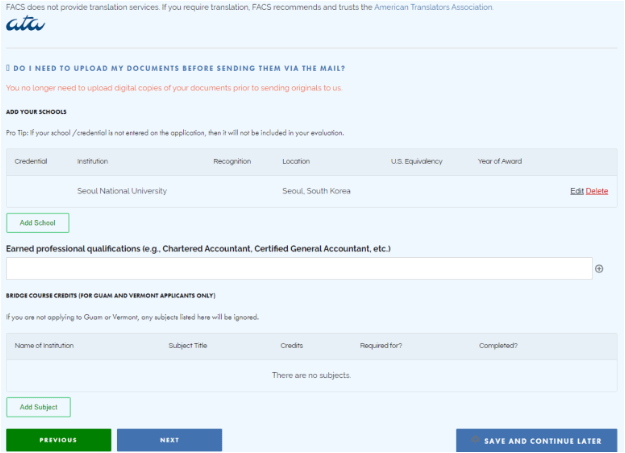
Most international applicants will choose:
“International Mailing Service”
You will also choose the processing speed.
Options generally include:
- standard expedited service
- 5-day rush service
If you plan to take the exam quickly, the 5-day option may be worth considering.
Otherwise, using the standard expedited service is usually more cost-effective.
And honestly… the USCPA process becomes expensive very quickly 😭
At the time I applied, even without selecting rush processing, the evaluation fee alone was already around $385.
Compared to the Korean CPA process — where submitting English scores and transcripts costs relatively little — the USCPA application process definitely feels much more expensive from the very beginning.
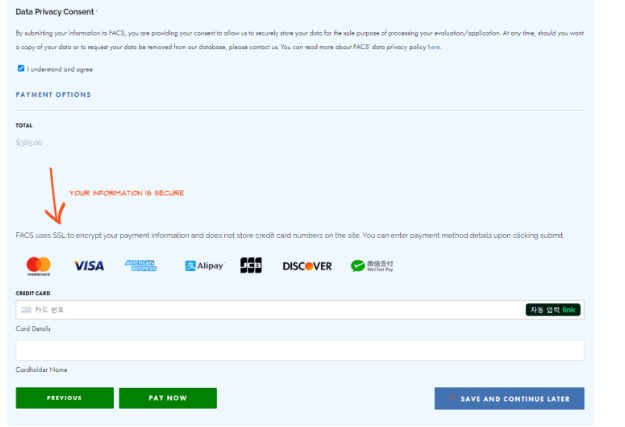
1-3. Final Confirmation & Payment
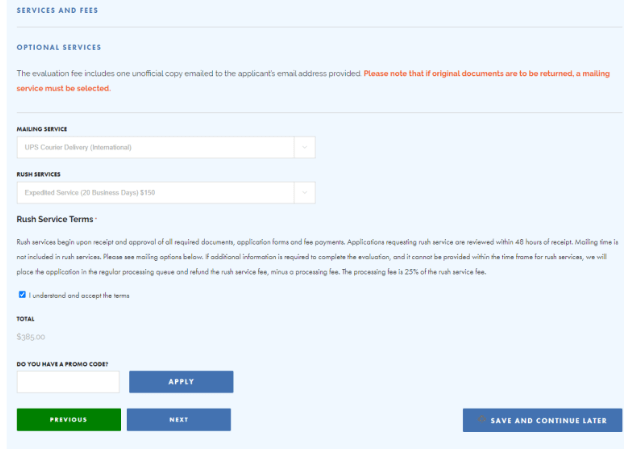
Once everything is completed:
- review your personal information
- provide your signature
- pay the evaluation fee
and the initial application process is finished.
2. Preparing the Required Documents
Required Documents
The exact requirements vary slightly by state, but commonly required documents include:
- Two sealed official English university transcripts
- Two sealed English graduation certificates
- Sealed transcripts for additional credit programs (if applicable)
- Recommendation letters (depending on the state)
- Notarized identification documents
Recommendation letters are generally quite formal and standardized.
For identification notarization, many international candidates use local law offices or notary services to verify identity documents before submission.
2-1. Sending the Documents
There are generally two approaches:
- sending documents directly yourself
- or using an academy/consulting service
Personally, even though I did not take academy classes, I still recommend using an experienced academy or consultant for the document submission process if possible.
Usually, you only need to pay the DHL shipping fee, and they help:
- organize the documents
- review missing materials
- and handle the shipping process
which can significantly reduce stress for first-time applicants.
If you plan to send documents directly yourself, the mailing address I used was:
ACS, INC.
105 West Vandalia Street Suite 120
Edwardsville, IL 62025
United States
Tel: +1-618-656-5291
Email:
transcripts@facsusa.com
Final Thoughts
In this post, I organized the evaluation and application process for international USCPA candidates, especially for those applying through states like Maine or Vermont.
Compared to domestic professional exams, the USCPA application process definitely feels:
- more complicated
- more expensive
- and slightly intimidating at first
But once you complete the first step, the process becomes much less overwhelming 🙂
In the next post, I’ll organize:
- NTS issuance
- exam scheduling
- and how the actual reservation system works.
Thank you again for reading 🙂
 Global CPA
Leave a comment