



Hello, this is Global CPA. ✨✨
Today, I want to share something that became incredibly important while I was preparing for the ACCA P-Level exams — especially AFM (Advanced Financial Management).
While preparing for the June exam session, I realized that many students focus heavily on technical calculations but underestimate one of the most important scoring areas in the Strategic Professional exams:
Professional Skills Marks
When I sat for SBR earlier, I honestly did not even fully understand what Professional Skills Marks were or how they were assessed. Somehow, I passed the exam without properly preparing for them. However, once I started solving AFM past papers and realized that Professional Skills Marks account for up to 20 marks, I immediately started researching and organizing the concepts.
The more I studied them, the more I realized how practical and useful they actually are — not only for the exam itself, but also for real professional work as an accountant.
So in this article, I want to summarize the Professional Skills Marks structure and explain how I personally understood each component while preparing for AFM.
(Students already studying P-Level exams may already know this, but I was genuinely excited that I finally understood it properly, so I wanted to organize everything here.)
1. What Are Professional Skills Marks?
According to ACCA:
“Professional Skills Marks are designed to assess key professional skills that are critical for future accountants.”
These skills are integrated into the Strategic Professional Option papers, including:
- AFM (Advanced Financial Management)
- APM (Advanced Performance Management)
- AAA (Advanced Audit and Assurance)
- ATX (Advanced Taxation)
When I first read ACCA’s explanation, I honestly had no idea what it actually meant. It felt like:
“Professional skills are assessed through Professional Skills Marks.”
Which did not help much at all. 😂
So I decided to break down the actual structure and understand what ACCA is truly looking for.
2. Structure of Professional Skills Marks
Professional Skills Marks are mainly divided into four categories:
- Communication
- Analysis and Evaluation
- Scepticism
- Commercial Acumen
At first, only “Scepticism” felt somewhat familiar because I had heard about professional skepticism repeatedly while studying for KICPA and USCPA. The others felt vague and abstract.
So let’s go through them one by one.
(This article focuses mainly on AFM, so students taking other P-Level papers should still check the official ACCA guidance.)
2-1. Communication — Structure Matters
Communication is exactly what it sounds like.
In real accounting work, professionals constantly write:
- reports
- memos
- emails
- presentations
And ACCA wants candidates to demonstrate those professional communication skills inside the exam.
In AFM especially, Section A almost always requires a report format, making Communication Marks extremely important.
Honestly speaking, Communication probably makes up the majority of Professional Skills Marks in AFM.
If I had gone into the exam without understanding this, I probably would have lost marks very badly.
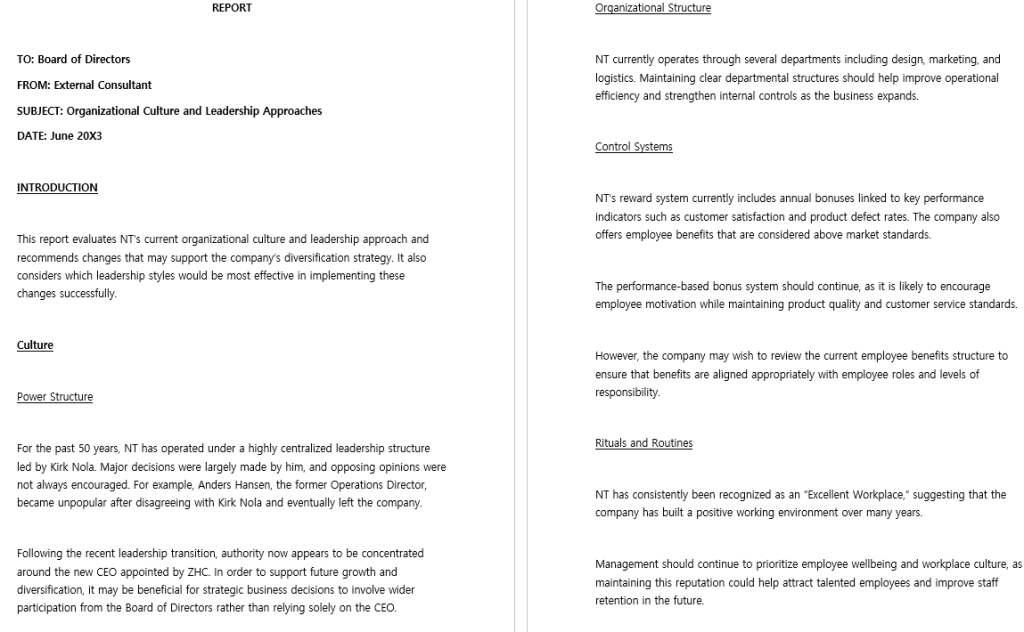
After watching examiner videos and reviewing ACCA guidance, I summarized the report structure that frequently appears in AFM.
Essential Report Structure
1) Report Heading
Should clearly include:
- who the report is for
- who prepared the report
- the purpose of the report
2) Introduction Paragraph
Should briefly paraphrase the requirement and explain the purpose of the analysis.
It is usually better to indicate the overall direction of the conclusion early.
For example:
- “The proposed project appears beneficial to the company.”
- “The acquisition may not be financially attractive.”
3) Subheadings
The report should have clear structure using subheadings.
My personal tip:
- use bold headings
- keep them short (3–4 words)
- follow the same order as the question requirements
This makes the report look significantly more professional.
4) Conclusion
The conclusion should:
- summarize the key issues
- briefly restate the recommendation
- mention limitations if necessary
- reference appendices or spreadsheet calculations
A concise 3–4 sentence conclusion is usually sufficient.
Additional Tips
- Write the report in the Word processor section and perform calculations in the spreadsheet section.
- Link calculations through appendices where appropriate.
- Avoid overly absolute wording such as “must.”
- Since P-Level exams often involve judgement and uncertainty, softer professional wording such as:
- “might”
- “could”
- “would”
often sounds more appropriate.
- Avoid informal expressions like:
- “I think”
- “I would like to say”
These reduce professionalism.
2-2. Analysis and Evaluation — Content Matters
According to ACCA:
“Any analysis or evaluation is contextual and must consider the situation in which the organisation operates.”
In other words:
your analysis must fit the company’s actual business environment.
For example:
- a public sector organization
- a profit-maximizing company
- a startup
- a mature manufacturing company
all require different perspectives.
Analysis
ACCA also explains that analysis should involve:
- identifying relevant information
- using appropriate calculations
- supporting conclusions with evidence
One particularly useful point was this:
Candidates should identify missing information or areas where further analysis is required.
I thought this was extremely important.
Sometimes while solving questions, you feel:
- “Something seems missing.”
- “This information alone may not be sufficient.”
Those moments can actually become opportunities to demonstrate professional judgement.
Evaluation
Evaluation means reaching balanced conclusions based on the analysis performed.
For example:
- “The project should proceed because the NPV is positive.”
- “The acquisition may not be advisable due to financing risks.”
The important point is:
you should not simply calculate numbers — you must interpret them professionally.
2-3. Scepticism — Professional Doubt
ACCA defines scepticism as:
“Having a questioning approach and not believing everything the client says.”
This felt very familiar from audit work.
Even in AFM, I believe skepticism can be summarized into two key ideas:
- Verify the reliability of assumptions and data.
- Check whether different pieces of information are logically consistent.
For example:
- the finance director says sales are increasing strongly,
- but the sales manager says customers are delaying payments significantly.
Both statements may explain rising receivables, but they imply very different business realities:
- growth opportunity
vs. - possible bad debt risk.
Identifying these inconsistencies is exactly what professional skepticism means.
2-4. Commercial Acumen — Understanding Business Reality
This was personally the hardest category for me to understand.
According to ACCA:
Organizations do not operate in a vacuum.
Candidates must consider:
- external constraints
- market conditions
- competitive environment
- internal limitations
- operational realities
This reminded me a little of strategic frameworks like Porter’s Five Forces.
Commercial Acumen is essentially:
understanding how real businesses actually operate.
For example:
- budget limitations
- industry competition
- economic conditions
- regulatory risk
- operational capacity
all affect whether a recommendation is realistic.
The examiner also mentioned that discussing the possible consequences of actions can help demonstrate Commercial Acumen.
Final Thoughts
Professional Skills Marks initially felt vague and confusing to me, but after studying them carefully, I realized they are actually testing something very practical:
“Can you think and communicate like a real professional accountant?”
Especially in AFM, understanding Professional Skills Marks can significantly improve your score.
With the June exam session approaching soon, I hope this article helps students preparing for ACCA P-Level exams.
Thank you again for reading this long post, and I hope your studies go well. ✨
 Global CPA
Leave a comment