

Hello Everyone, this is Global CPA.✨✨
Today I would like to share how I prepared for the ACCA FR (Financial Reporting) exam that I took in December 2023 and what I learned from the experience.
My FR Result
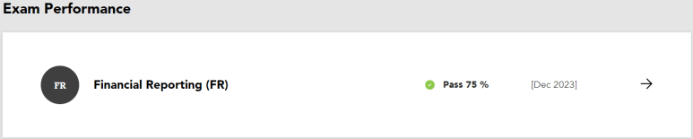
I passed the FR exam with a score of 75.
Honestly, I was quite relieved.
FR consists of three sections, and Section A and Section B are primarily objective-style questions. Because of that, I approached the exam somewhat similarly to how I approached the USCPA exam.
At the time, I was still working full-time while going through interim audit work and operational testing. I also did not spend enough time practicing ACCA-style written responses with structured “introduction-body-conclusion” writing.
My mindset was honestly quite simple:
“I probably cannot master everything perfectly, so I should focus on understanding the core concepts as efficiently as possible.”
Fortunately, that strategy worked better than I expected.
Why I Chose OpenTuition
After passing the USCPA in July 2023, I started thinking about what challenge I wanted to pursue next.
One of my biggest concerns at that time was cost.
I had already spent a significant amount of money preparing for the USCPA:
- exam fees,
- review courses,
- registration fees,
- study cafés,
- and other expenses.
Because of that, I promised myself that if I pursued another qualification, I wanted to study in a much more cost-efficient way.
That was when I discovered OpenTuition.
What surprised me the most was that such high-quality study materials were provided completely free of charge.
Compared to the extremely expensive study environments surrounding KICPA or USCPA preparation, this felt almost unbelievable to me.
OpenTuition provides:
- free lecture notes,
- free video lectures,
- practice support,
- and exam-focused explanations
for ACCA and other professional qualifications.
I also liked the fact that when I struggled to understand certain concepts from the notes alone, I could immediately watch the corresponding lectures on the official OpenTuition YouTube Channel.
Their motto is:
“The best things in life are free.”
For an accounting qualification ecosystem, that almost felt strangely anti-capitalistic.
Was OpenTuition Enough?
Personally, I believe OpenTuition was more than sufficient for building core conceptual understanding.
Of course, students aiming for extremely high scores may prefer more comprehensive materials such as Kaplan or BPP.
However, for someone like me — a working professional with limited study time whose immediate goal was simply to pass efficiently — OpenTuition worked very well.
In fact, one advantage was that the materials were concise.
Instead of reading excessively detailed explanations, I was able to:
- organize concepts quickly,
- move into past paper practice earlier,
- and focus on high-yield topics.
For FR, SBR, and even AFM, I personally found OpenTuition highly effective.
I think this is especially true for students who already have some familiarity with IFRS or US GAAP concepts through prior study or professional experience.
ACCA Study Hub Was Surprisingly Useful
Another resource I used heavily was the ACCA Study Hub provided to ACCA students.
I found this platform surprisingly helpful.
One thing I particularly liked was that it allowed me to review concepts almost like flashcards during commuting hours.
The platform also included:
- practice questions,
- explanations,
- and model written answers.
Since English writing was one of my weaker areas, this became very useful because ACCA FR includes constructed-response questions unlike the mostly multiple-choice USCPA format.
To practice written responses, I sometimes typed out model answers myself while studying.
My Study Timeline
I studied for FR from early October to early December.
One thing I learned once again during this process is that my study efficiency is extremely honest.
If I invest 10 units of effort, I get almost exactly 10 units of output — not much more.
At first, I completely underestimated FR.
Since I had:
- already studied KICPA,
- passed the USCPA,
- and worked with IFRS professionally,
I foolishly imagined that I could quickly finish FR and maybe even prepare for SBR and AFM simultaneously for the December session.
That fantasy disappeared after about two days of studying FR.
Even though the subject was based on IFRS, many concepts were approached differently from what I was used to in practice or Korean accounting education.
Group Financial Statements, in particular, felt almost completely different from what I initially expected.
Eventually, I realized I needed to focus entirely on FR for those three months and postpone SBR to a later session.
Looking back now, that was definitely the correct decision.
October: Concept Building with OpenTuition
During October, my primary goal was simple:
Finish the OpenTuition materials and fully understand the core concepts.
I repeatedly reviewed:
- lecture notes,
- examples,
- and practice questions.
Some of the topics I focused on most heavily included:
- Group Financial Statements,
- PPE revaluation and impairment,
- cash flow statements,
- discontinued operations,
- financial instruments,
- and sale-and-leaseback transactions.
Because my study time was limited, I prioritized mastering the accounting treatment itself before moving aggressively into question practice.
Personally, I believe financial reporting subjects are highly dependent on conceptual accounting accuracy.
November: Past Papers and Examiner’s Reports
After building conceptual understanding, I shifted almost entirely toward:
- past papers,
- mock exams,
- and Examiner’s Reports.
One thing I genuinely liked about ACCA was how transparent the examination process felt.
Unlike many other qualification systems, ACCA examiners actively explain:
- common mistakes,
- marking expectations,
- and what strong answers should look like.
I found the Examiner’s Reports especially valuable because they helped me understand how the examiners themselves think.
Even though I only completed:
- one full past paper,
- and one mock exam,
I spent a significant amount of time reading multiple Examiner’s Reports and organizing recurring mistakes into my notebook.
I also continued my usual habit of creating condensed handwritten summary notes while studying.
Exam Day Experience
The exam day itself was surprisingly stressful.
I was already used to taking exams at physical testing centers, but taking the ACCA exam remotely from home felt very unfamiliar.
The webcam setup process alone took much longer than I expected.
At the time, I also did not realize that I needed to close my laptop while using an external monitor, so I ended up taking the entire exam on a 13-inch laptop screen.
As someone used to studying and working on a 24-inch monitor, that was honestly painful.
Still, I was simply happy to be able to sit for the exam.
The multiple-choice sections went relatively smoothly, but Section C was much more difficult.
I spent far too much time reading and organizing my responses.
Although I managed the Group FS question reasonably well, I could not fully complete one PPE-related question before time ran out.
Looking back, I think I underestimated how much Section C preparation was needed.
Final Thoughts
If I had to summarize my FR preparation strategy, it would look something like this:
- OpenTuition for conceptual learning
- Past paper practice
- Examiner’s Reports
- Condensed handwritten notes
And perhaps most importantly:
Spend more time practicing Section C than you initially think you need.
I would especially recommend this approach for:
- working professionals,
- students with prior accounting knowledge,
- or candidates with limited study time.
For students completely new to accounting, more structured textbooks such as Kaplan or BPP may still provide a stronger foundation.
Overall, however, I genuinely enjoyed the ACCA learning experience much more than I initially expected.
I will continue sharing my experiences as I move forward with SBR and the rest of the ACCA journey.
Thank you for reading.
 Global CPA
Leave a comment