



Hello Everyone, this is Global CPA✨✨
After sharing my experiences with FR and SBR, I wanted to write honestly about another important part of my ACCA journey — my failed attempt at AFM (Advanced Financial Management).
Unlike my previous posts, this is not a story about an efficient strategy that worked well.
Instead, this post is more about:
- what I underestimated,
- where my preparation was insufficient,
- and what I learned from failing the exam by just two marks.
My AFM Result: 48
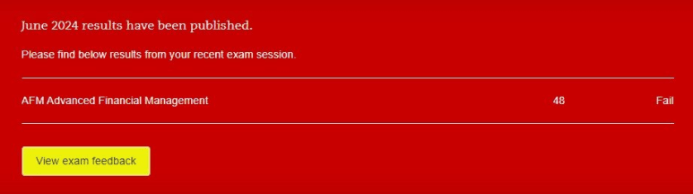
I failed AFM with a score of 48.
To be honest, while waiting for the result, I already had a bad feeling about the exam.
Still, seeing “48” on the screen was painful.
Ironically, it also reminded me of my old KICPA days when I missed passing Financial Management by only 1.5 points and had to continue as a partial-pass candidate the following year.
Looking back now, I do not think I failed simply because of “bad luck.”
Rather, I think the result was the accumulation of many small mistakes and moments of overconfidence.
My Overall Study Strategy
Compared to my previous FR and SBR posts, this post is probably closer to:
“What not to do while preparing for AFM.”
AFM is essentially advanced corporate finance and risk management.
If I compare it loosely to other qualifications:
- KICPA: Advanced Financial Management / Derivatives
- USCPA: BEC or BAR financial management topics
- ACCA: AFM
Personally, I would roughly rank the difficulty as:
KICPA 2nd Advanced Financial Management > ACCA AFM >> KICPA preliminary-level finance > USCPA Financial management
At first, after passing USCPA and working professionally for several years, I mistakenly thought:
“I probably already understand financial management concepts fairly well.”
That assumption disappeared very quickly once I opened the AFM materials.
Topics such as:
- foreign exchange hedging,
- option pricing,
- Black-Scholes models,
- and advanced risk management
felt much more difficult than I expected.
Step 1: OpenTuition and Concept Review
I began by studying through OpenTuition again.
My goal at that stage was:
- to understand which concepts were actually examinable,
- organize the syllabus structure,
- and build condensed handwritten summary notes.
I also reviewed:
- old KICPA financial management notes,
- OpenTuition YouTube lectures,
- and supplementary explanations whenever concepts felt unclear.
This process alone took almost three weeks.
Compared to FR and SBR, the conceptual difficulty of AFM felt significantly higher.
One thing that particularly felt unfamiliar was currency-related calculations.
As someone accustomed to thinking primarily in Korean won, suddenly solving hedging problems entirely through pounds and dollars felt surprisingly awkward at first.
The Biggest Mistake: Underestimating the CBE Platform
Looking back now, I think the biggest reason for my failure was simple:
I underestimated the importance of ACCA’s CBE practice platform.
For FR and SBR, I had solved relatively few past papers but still achieved decent results because I already worked heavily with financial reporting concepts in practice.
That created overconfidence.
In AFM, however, practical audit experience was much less directly transferable.
I only spent around two weeks seriously practicing through the CBE platform while simultaneously dealing with:
- interim review work,
- internal control projects,
- and other professional responsibilities.
Deep down, I still had the dangerous mindset of:
“Maybe solving just a few past papers will be enough.”
That assumption turned out to be completely wrong.
Important AFM Themes
From reviewing past papers and candidate experiences, the major recurring AFM themes seemed to include:
- Investment appraisal (DCF / NPV)
- Financing decisions and WACC
- Risk management
- Foreign exchange hedging
- Interest rate hedging
- Strategic acquisitions
- Business valuation
At least two or three of these themes seem to appear heavily in almost every sitting.
If I could give one major piece of advice now, it would be this:
Do not only understand the concepts.
Practice applying them repeatedly under exam conditions.
AFM is heavily technique-driven.
Exam Day Experience
I booked the exam for 6:30 PM and logged in after a quick dinner.
Even before the exam started, there was already some stress because the remote proctor informed me that I could not use my monitor stand.
Since I normally study and work with elevated monitor positioning because of neck discomfort, this immediately made the setup less comfortable.
Still, that was not the real problem.
Section A: International Expansion and Hedging
Section A was actually manageable.
The question involved:
- international business expansion,
- foreign exchange risk,
- hedging strategies,
- and NPV calculations.
Fortunately, I had practiced those areas enough to stay relatively calm.
DCF and valuation-related questions also felt familiar because I had encountered similar concepts professionally.
Looking back, I think most of my final 48 marks probably came from Section A alone.
Section B: Black-Scholes Completely Destroyed My Confidence
Section B was where everything started collapsing.
The moment I saw Black-Scholes option pricing, I froze.
Ironically, ACCA even provides the calculation template inside the exam system, meaning the technical computation itself is not impossible.
But psychologically, I had already decided beforehand:
“Black-Scholes is probably not a high-frequency topic.”
So I barely practiced it.
That decision became fatal.
Instead of calmly writing partial answers and collecting whatever marks I could, I panicked and wasted almost twenty minutes mentally overwhelmed by the question.
Looking back now, I probably could have earned a few more marks simply by staying calm and attempting structured discussion points.
Section C: Strategic Acquisition Under Pressure
By the time I reached Section C, my confidence was already badly damaged.
The question itself was not impossible.
It involved evaluating:
- a strategic acquisition,
- corporate suitability,
- and broader business considerations.
Under normal conditions, I probably could have handled it reasonably well.
But because I believed I had already failed Section B badly, I became increasingly nervous and rushed.
I only had around thirty minutes left when I fully regained focus, and eventually I could not complete the final requirement properly before time ran out.
What I Would Do Differently
If I prepare for AFM again, my strategy will change significantly.
I will still:
- review concepts through OpenTuition,
- maintain condensed handwritten notes,
- and organize key formulas.
But this time, the primary focus will be:
- repeated CBE practice,
- broader past paper coverage,
- and technical application speed.
Previously, my mindset was:
“Understand concepts first.”
Now I think AFM requires:
“Understand concepts AND repeatedly train application technique.”
Those are not the same thing.
My Biggest Lesson From Failing AFM
Oddly enough, failing AFM taught me something valuable.
As working professionals, we often try to optimize everything:
- time,
- efficiency,
- minimum input for maximum output.
That strategy worked reasonably well for FR and SBR.
But AFM showed me the limits of that approach.
Some subjects simply require:
- repetition,
- technical familiarity,
- and enough practice to remain mentally stable under pressure.
Looking back honestly, I do not feel like I “unluckily missed by 2 points.”
I feel like I failed because my preparation was incomplete.
And strangely enough, I think recognizing that clearly makes the next attempt psychologically easier.
Thank you for reading.
 Global CPA
Leave a comment