


Hello Everyone, this is Global CPA✨✨
In my previous post, I talked about the overall study strategy I used for the three ACCA papers I attempted in December.
In this post, I would like to focus specifically on AAA (Advanced Audit and Assurance):
- how I studied,
- how my study method evolved over time,
- what appeared in the December exam,
- and how I managed my time during the actual paper.
1. Study Timeline and Study Method
September: Rebuilding Momentum With AAA
I officially restarted ACCA preparation in September with AAA.
After failing AFM in June, combined with:
- wedding preparation,
- interim review work,
- and overall burnout,
my confidence had dropped significantly compared to earlier in the year.
So when choosing between:
- AAA,
- SBL,
- and AFM,
I decided to start with the subject I felt most comfortable with: AAA.
At that stage, I had not yet fully discovered webinar-based learning or optimized my ACCA study process. So I initially returned to my old method:
organizing concepts through OpenTuition.
However, unlike before, I did not try to memorize everything mechanically.
Instead, I focused more on:
- understanding what kind of subject AAA actually was,
- identifying unfamiliar ISA concepts,
- and distinguishing differences between:
- KICPA audit approaches,
- real audit practice,
- and ACCA-style audit discussions.
Whenever I encountered concepts:
- I had not experienced directly in practice,
- or areas that seemed heavily examinable,
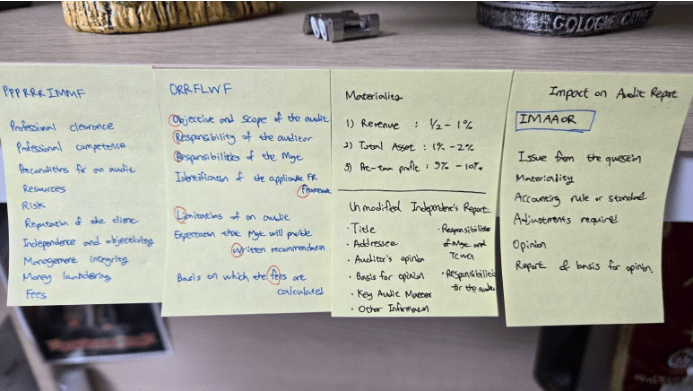
I highlighted them, attached sticky notes, and organized them visually rather than simply trying to memorize everything immediately.
October: Technical Articles Changed My Approach Completely
Around October, my study method changed dramatically.
While watching SBL lectures from Hassan Dossani, I discovered VIFHE and started exploring a much broader ACCA learning ecosystem.
At this point, I stopped relying primarily on OpenTuition notes.
Instead, I:
- printed ACCA Technical Articles as hard copies,
- organized only the absolutely essential concepts into condensed notes,
- and shifted my focus toward:
- application,
- exam structure,
- and professional discussion points.
The only concepts I intentionally memorized were:
- possible sub-heading concepts for answers,
- and benchmark figures for materiality.
Throughout October, my study routine became:
- SBL webinars at night,
- Technical Articles during lunch breaks at work,
- and concept review whenever possible.
I often spent:
30 minutes during lunch reading Technical Articles, then immediately returning to audit work afterward.
As a working professional, maximizing fragmented study time became extremely important.
November: Past Papers Became Everything
By November, I finally started feeling more comfortable with the core AAA concepts.
At that point, I made one major decision:
Solve one full past paper every single week.
Looking back now, I think this was probably the single most important decision that allowed me to survive the December exam season.
One of the biggest reasons I failed AFM earlier in the year was that I had not analyzed past papers deeply enough.
I simply did not understand:
- what examiners wanted,
- how much detail was expected,
- or how answers should actually be structured under time pressure.
Because of that experience, I became almost obsessed with past papers during AAA preparation.
For all three subjects:
- AAA,
- SBL,
- and AFM,
I forced myself to:
- Solve one past paper every week
- Watch debriefing lectures on YouTube afterward
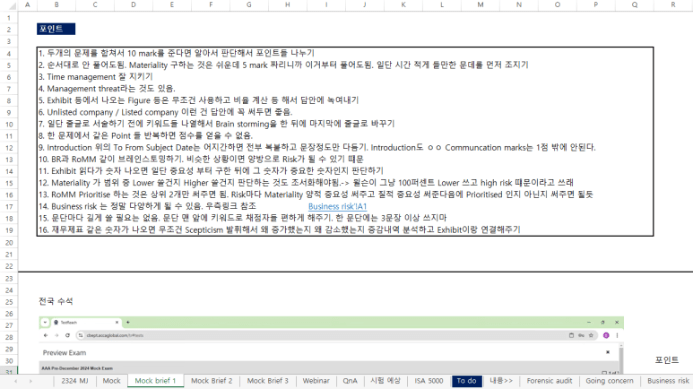
- Organize mistakes and missing discussion points into Excel notes
Whenever I discovered:
- missing concepts,
- weak technical areas,
- or poor answer structures,
I immediately added them into my condensed review files.
Looking back, I honestly think:
Technical Articles + repeated past paper analysis + debriefing lectures
would probably have been sufficient by themselves.
At some point, I finally realized something important about ACCA exams:
ACCA is not testing how much information you can memorize.
It is testing how effectively you can organize relevant points from exhibits into structured professional discussion.
That realization completely changed how I approached studying.
Choosing the Right Lecturers
At first, besides Hassan Dossani for SBL, I honestly had no idea which lecturers were worth following.
So I spent time testing many different instructors based on two simple criteria:
- Can the lecturer clearly teach:
- question analysis,
- answer structure,
- and exam technique?
- Can I clearly understand the lecturer’s pronunciation?
Since English is not my first language, pronunciation clarity mattered enormously for me.
Eventually, for AAA, I found Ben Wilson’s lectures especially effective.
His:
- British pronunciation,
- structured explanations,
- and practical answer organization methods
fit my learning style very well.
Using AI and YouTube More Efficiently
One tool I found surprisingly useful was:
The platform summarizes YouTube lectures into structured outlines and timestamps using AI.
This made it much easier to:
- preview lecture structure,
- identify whether a lecture was worth watching,
- and locate important discussion sections efficiently.
Combined with ChatGPT-based script summarization, this significantly improved my study efficiency during busy season.
The Day Before the Exam
On December 1st, the day before the exam, I:
- rewatched ACCA’s official RTMM sessions,
- reviewed condensed Excel summary notes,
- practiced identifying Business Risks from recent past papers,
- and then intentionally went to sleep very early.
For the first time in a while, I actually slept around eight hours before an ACCA exam.
Honestly, that alone felt like a victory.
2. December Exam Experience and Time Management
Exam Day
On December 2nd, I woke up feeling surprisingly refreshed.
I still had interim audit fieldwork that day, so I went to the client site in the morning, participated briefly in the kickoff meeting, gave directions to staff members, and then spent roughly three hours lightly reviewing my condensed notes before leaving work early.
After returning home around 5 PM:
- I took a short nap,
- reviewed my Excel summary notes one final time,
- and then sat for the exam at 8:30 PM.
The Questions I Received
The exam consisted of:
- PPE CGU impairment and contamination-related issues (98 minutes)
- Goodwill-related issue (49 minutes)
- Audit report review and completion procedures (49 minutes)
Time Management Was Everything
One thing every lecturer repeatedly emphasized was:
“Time management.”
So before starting the exam, I wrote target completion times for each question directly onto the scratch pad.
Then, exactly as Ben Wilson recommended, I:
- identified sub-headings first,
- organized answer structure,
- and only then started reading the exhibits carefully.
Looking back, one of the best decisions I made was this:
The moment my allocated time expired, I moved on to the next question even if the answer felt incomplete.
This is extremely important in AAA.
The exam is fundamentally about:
- identifying as many relevant points as possible,
- organizing them professionally,
- and collecting marks efficiently within limited time.
At some point, chasing a few additional marks in one requirement becomes less valuable than moving to a fresh question where many marks are still available.
My Final Thoughts on AAA Preparation
The results had not yet been released when I originally organized these thoughts, so I could not confidently say:
“This method is perfect.”
However, if I had to summarize the study strategy I personally found most effective, it would look something like this:
- Solve the Specimen Exam first and explore the structure of AAA
- Read Technical Articles and organize core concepts
- Solve Past Papers and watch debriefing lectures sequentially
- Repeat the process multiple times
If I ever restarted AAA preparation from scratch, I would probably follow exactly this structure again.
Of course, official ACCA model answers are still useful references.
However, realistically speaking, writing answers at that exact level during the real exam is extremely difficult under time pressure.
Even ACCA itself acknowledges that many model answers are written primarily for learning purposes.
So unless someone is specifically aiming for exceptionally high marks, I personally think:
understanding answer structure and examiner expectations matters more than trying to reproduce model answers perfectly.
I will continue with my SBL experience in the next post.
Thank you for reading.
 Global CPA
Leave a comment